How to Choose a Commercial Bathroom Cleaning Machine
Buy one as your deep-clean tool, not as a faster mop. The machine reaches what a mop only pushes around: grout lines, floor drains, the base of toilets and urinals, and the bottom edge of every partition. Most teams run it weekly or monthly, or after a restroom gets trashed, and keep the nightly routine quick with spray bottles and microfiber.
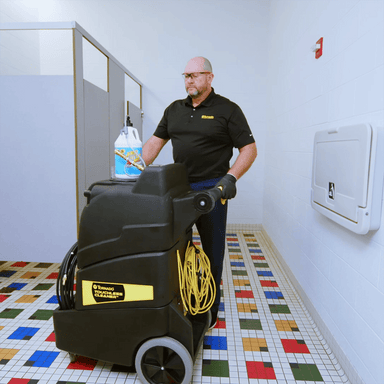
Who uses them. Schools are the classic setting, where custodians save the machine for a weekly project night or a school break. The same machines suit gyms and locker rooms, churches, stadiums and arenas, retail and grocery stores, prisons and airports: anywhere with busy restrooms and tile that can take a rinse.
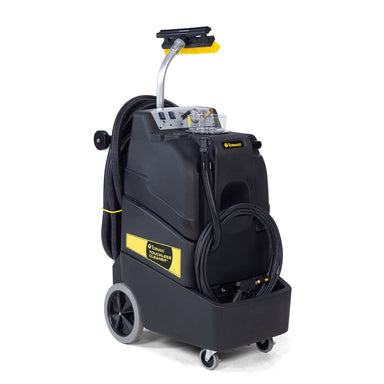
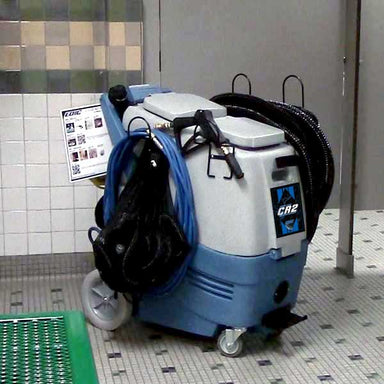
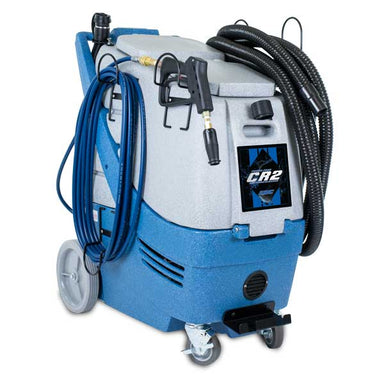
Compare the NaceCare PT 30, the EDIC CR2 and CR2 Jr, the Tornado Touchless Restroom Cleaner and the Clarke TFC 400 on these points:
- Tank size vs restrooms per session. One fill gives you about 7 minutes of spraying on the PT 30, 14 on the CR2 Jr and 20 on the CR2 or TFC 400. Dwell time, rinsing and vacuuming take up most of a clean, so one fill covers several restrooms. Bigger tanks pay off when you clean many multi-stall rooms in a row, far from a sink.
- Pressure and flow. Pumps run from 220 psi on the PT 30 to 550 psi on the CR2. More pressure lets you flush grout and the base of fixtures faster. Flow decides how quickly you rinse a room and how fast the tank empties.
- Vacuum strength. Water lift runs from 81 inches on the TFC 400 to 138 inches on the CR2. Stronger lift pulls more water out of grout, so your floor dries sooner.
- Weight and maneuverability. The machines weigh 77 to 152 pounds. If you work across stairs, elevators, narrow doors and small closets, the PT 30 and the 18-inch-wide CR2 Jr are the easiest to move.
- Hose and cord length. Published solution hoses run 25 to 50 feet and cords 25 or 50 feet. With longer reach, you move the machine less between the outlet and the far stall.
- Hot or cold water. None of these heats water. Fill limits are 120°F on the Clarke, 130°F on the EDIC and 135°F on the Tornado, and the PT 30 takes cold water only. The CR2 accepts EDIC's external heater if you also clean carpet.
- Warranty. Coverage differs by brand and by part, so check the manufacturer's terms on each product page.
When a machine isn't the answer. These machines need surfaces built to get wet. Wood or pressboard partitions and wood cabinets soak up water, so clean those by hand. If you look after two single-stall restrooms, restroom cleaning equipment this size is more than you need, and a spray bottle and microfiber cost less. If carpet is most of your work, start with portable carpet extractors, which are built for that job.
Tell us how many restrooms you clean, how big they are and how far they sit from a sink, through the contact page or at (855) 601-5678, and we'll point you to the right machine. Unused machines fall under our 30-day return policy.
Touch-Free Restroom Cleaning Machines Compared
| Model | Solution / recovery tank | Pump | Vacuum | Hose length | Cord | Weight | Max water temp | Best for |
|---|
| NaceCare PT 30 | 8 / 8 gal | 220 psi, 1.2 gpm | 1,000 W 2-stage, 100 in lift | See spec sheet | 50 ft | 77 lb | Cold only | Small and mid-sized restrooms on a tighter budget |
| EDIC CR2 Jr (2000RC) | 12 / 11 gal | 550 psi, 0.86 gpm | 3-stage, 138 in lift | 50 ft solution, 45 ft vacuum | 25 ft | 89 lb | 130°F | A few restrooms per shift, tight closets and elevators |
| EDIC CR2 (2700RC) | 17 / 15 gal | 550 psi, 0.86 gpm | 3-stage, 138 in lift | 50 ft solution, 45 ft vacuum | 50 ft | 108 lb | 130°F, heater ready | Many large restrooms in a row, plus a carpet bundle option |
| Tornado Touchless (TP490-G15-U) | 15 / 15 gal | Up to 500 psi | 1,591 W, 125 in lift | 40 ft solution, 25 ft vacuum plus stretch | 25 ft | 152 lb operating | 135°F | Large multi-stall restrooms, with tools and chemical stored onboard |
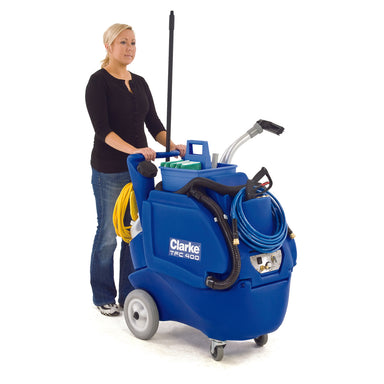
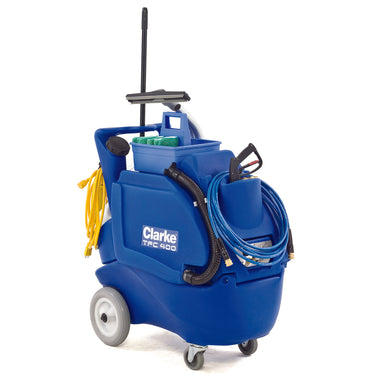
| Clarke TFC 400 | 20 / 13 gal | 400 psi, 1.0 gpm | 900 W 2-stage, 81 in lift | 25 ft solution, 25 ft vacuum | 25 ft | 86 lb | 120°F | Restrooms, locker rooms and hallways from one big tank |
Restroom Cleaning Machine FAQ
Are bathroom cleaning machines worth it?
Usually, if you clean several busy restrooms. A machine removes the soil a mop leaves in grout and around fixtures, and your floor dries fast enough to reopen the room. For one or two small single-stall restrooms, spray bottles and microfiber cost less. The guide on whether touchless restroom cleaning machines are worth it works through the labor math for your restroom count.
How long does it take to clean a restroom with a touchless machine?
It depends mostly on training. One custodial account manager puts a trained operator at about 15 minutes for a 10 to 12 stall restroom, dwell time included. When it runs long, the usual causes are a machine too small for the rooms, which means refills, or flooding the room with chemical instead of laying down a light coat. See how touchless restroom cleaners work, step by step.
Can you use one in a restroom with no floor drain?
Yes. The vacuum recovers the rinse water through the floor tool, so a drain is optional. If the room has one, you can squeegee water toward it, though many older floors don't slope to the drain anyway. Watch the recovery tank on the TFC 400: it holds 13 gallons against 20 of clean water, so empty it before it fills.
Should it run every night or only for deep cleans?
Mostly for deep cleans. Custodians who run these machines tend to schedule them weekly, on a project night or a school break, and twice a week for the worst restrooms. The nightly clean stays quick with spray bottles and microfiber, as in the restroom cleaning checklist. Nightly machine use works too if your staffing allows it.
What chemicals can go in the tank?
Only clean water, on most models. Tornado, EDIC and NaceCare all want chemical drawn through the machine's metering system or sprayed on first, never poured into the solution tank, and the Clarke meters it from its own chemical compartment. Use restroom cleaners, neutral cleaners or disinfectants at label dilution, and add defoamer when foam shows up. EDIC rules out bleach and ammonia. Read which chemicals work in a touchless restroom cleaner.
How do you avoid water spots after the rinse?
Dry the fixtures before the water does. After the vacuum pass, blow chrome, faucets and counters dry, or squeegee mirrors and wipe chrome with microfiber. The CR2 ships with a blower tool, a hand squeegee and a microfiber towel, the PT 30 includes a blower hose, the Tornado has an air vent for assisted drying, and the TFC 400 blows from its vacuum exhaust with an optional hose.
Why does the GFCI trip when I spray?
Usually because water reached the plug, the outlet or the cord connection. A GFCI cuts power when it senses current leaking, which is its job around this much water. Plug into a grounded outlet away from the spray, keep the cord connection dry, and skip long or light extension cords: EDIC calls for 12-gauge, three-wire cords no longer than 25 feet. If it keeps tripping with everything dry, take it to an authorized service center.
Will it work around wood partitions or cabinets?
Not well. These machines wet every surface they clean, so they need tile, grout, fixtures and partitions made to take water. Wood or pressboard partitions and wood cabinets soak it up and swell, so clean those by hand and keep the spray off them. Keep it off hand dryers, light switches and sensor faucets too.
Is this a Kaivac alternative?
Yes. Kaivac machines clean restrooms the same way, with spray, rinse and vacuum, and the four machines here are the options we carry in that category. We don't sell Kaivac. The Kaivac alternatives comparison lines up the Tornado, CR2, TFC 400 and PT 30 on tank size, pressure, warranty and the chemicals you can use.
How much does a touchless restroom cleaning machine cost?
The machines here run from $3,449 to $6,518. Price climbs with tank size: the 8-gallon NaceCare PT 30 is the entry point, the CR2 models and the Tornado sit in the middle, and the 20-gallon Clarke TFC 400 tops the range. Match the tank to your restroom count before you pay for capacity you won't use.